June 25th, 2009 | Categories: Articles from the Press | Tags:

So crowded are our health resorts in the “season” that new one, especially if it be good and near London, is sure to prove attractive. So we are pleased to call attention to what, controlled by Mr. F. N. Charrington, promises to be an interesting, perhaps even an ideal, pleasure place. Since Robinson Crusope’s adventures charmed the people of many lands, island life has always possessed a peculiar fascination; and life on an island, with “all the latest improvements” – including the exclusion of drink – is what Mr. Charrington offers us within forty miles of the Metropolis.

The plan is this: Mr. Charrington has recently purchased Osea Island, of which probably few of us have even heard. It is the coast of Essex, within five miles of the ancient port and town of Maldon in Essex, and Maldon is only thirty six miles by road from the Metropolis. The length of the island is bounded on three sides by about a mile of sea, and the east side is open to the ocean. This place, which has an interesting history and many other attractions, especially for visitors, Mr. Charrington intends to develop into a popular seaside resort, and he is disposing of the land for this purpose, under stringent restrictions that will prevent a license of any kind, or any club for the sale of intoxicating drink, existing there. Mr. Charrington believes temperance is necessary to health. On Osea Island, temperance will be compulsory, and he thinks this will be a grand opportunity for philanthropists and those interested in social reform, to start any scheme of their own in the shape of convalescent homes and inebriate retreats in a prohibition territory, entirely surrounded by the sea.

Osea Island: Ships at Anchor. Low Tide.

Osea Island: Ships at Anchor. Low Tide.

Osea Island is described as very healthy, and during the winter months is actually milder than the mainland. Bathing can be safely indulged in at all times of the tide; the surrounding water is pleasant for sailing; and there are exceptional facilities for fishing and shooting. Whiting, plaice, dabs, soles, codlings, bass, mullets are to be had; and in the description Mr. Charrington sends us it is added that “porpoises, whales and dolphin may be seen disporting round the island at times.” Surely the hearts of fishermen will rejoice! Wild fowl seem to like being shot there. It is stated that one Maldon man once shot 75 widgeon at one shot, and the further record is given of a gunner who fired into a flock of coots, when a great gull was hovering over them and bagged 63. Maldon gunners should be more famous than they are, for another performance is described of a townsman who shot 120 geese in three successive shots. On Osea Island the archaeologist and botanist is also provided for.

For all your drug addiction, heroin addiction, executive burnout and sex addiction questions: +44 (0)207 100 7260

June 25th, 2009 | Categories: Articles from the Press | Tags:

Osea Island, situated on the East Coast in the Blackwater Bay, in the county of Essex, between the mouth of the Thames and Clacton-on-Sea, has recently been purchased by Mr. F. N. Charrington, for the purpose of developing it as a seaside health resort, and, at the same time, carrying out a great temperance scheme. The whole of the land is to be let or sold under the express condition that no license of any kind whatever, or clubs for the sale of intoxicating drink, will be permitted. The island will be the nearest deep sea resort to London, being only 40 miles by road, and within five miles of Maldon, between which and Osea twin-screw passanger steamer will run.

The Osea Island is currently being managed by the world’s first and only addiction treatment and mental health clinic, The Causeway Retreat. For more information about this beautiful island and its facilities, give them a call: +44 (0)207 100 7260.

June 15th, 2009 | Categories: History | Tags: , ,
This entry is part of a series, History»

“Here is Osey or Osyth Island, commonly called Oosey Island, so well known by our London Men of Pleasure for the infinite number of Wild-fowl that is to say, Duck Mallard, Teal and Widgeon, of which there are such vast flights that they tell us the island, namely, the Creek, seems covered with them at certain times of the year, and they go from London on purpose for the pleasure of Shooting; and, indeed, often come home very well loaded with game.”

Without going too much into detail, we may, I think, quote the words of a sporting Essex squire, who is still living, to confirm them. Mr. Thomas Kemble, of Runwell Hall, says:

“I am now going to relate what possibly sportsmen who go down there at the present day for wild-fowl shooting will not believe. I have seen the sky darkened with wild-geese covering a space of half-a-mile by a quarter-of-a-mile, as thick as manure spread upon the ground, and making a noise which I could only compare with fifty packs of hounds in full cry. I have also seen seven acres at low water covered with Widgeon, Curlew and Ducks, making such a noise that I could not hear my brother talking to me a few yards off. Colonel Russell was off the coast in his yacht. He told me that he had sent off from Maldon to London upwards of two tons of geese.”

The immense flocks of Brent Geese, or Black Geese, as they are termed locally, frequently still to be seen at the mouth of Blackwater during winter, can hardly be credited without ocular demonstration, and it is that we recommend; this is a sight well worth anyone’s seeing, and there are many men with boats to be found at Maldon who can at the proper time give every information as to the how, where, and when this is to be managed. We can hardly be expected to give details as the books we have already mentioned. Folkard, in the third edition of his Wild-fowler, writes, “The gunning-punts of the eastern coast are of considerable reputation, particularly those in the neighbourhood of Maldon, in Essex, the form of which is much in favour with those who resort to the pursuit of punting in winter as a means of subsistence.” All the best punts are built in Maldon, and the builders will give an intending purchaser any information that may be necessary.

Osea Island: Looking out to Sea. Post for securing boats.

Osea Island: Looking out to Sea. Post for securing boats.

We may perhaps give some idea of what the Black-water may produce by noting some of the authentic performances that have come to our notice. Charles Hipsey, of Maldon, once shot, and 12 to 15 more were picked up by other punters. Mr. E. F. Sheppard, son of the rector of Wrabness, records that a gunner fired into a flock of Coots, when a Basham, of Maldon, has the gun with which Girton, of himself bagged 50 Coots at a single shot. Basham himself bagged 288 Oxbirds (Dunlin) at a single shot from a flock settles on the ice, and the gulls and crows took several dozen besides. Harry Handley, of Maldon, once shot 432 Oxbirds (Dunlin) in two successive shots in Stansgate Bay. John Basham, junr., of Maldon, shot 108 Marl (Knots), in one shot out of a flock resting on the mud flats near Bradwell Chapel. Charles Hipsey, of Maldon, shot 320 Knots in one shot, just as many birds as there were shots in his gun (1/2lb. A.A. shot). Frank Hope, of Maldon, once shot 75 Curlew at once. Enormous “bags” of black geese might be recorded. In January, 1871, 14 guns shot 471 birds at once; 32 guns bagged 704 on another occasion, and 18 guns bagged 360. Of single shots at geese, Stubbins, of Maldon, once killed 50 at the mouth of Thurslet Creek, and William Handley, of Maldon, once shot 120 geese in three successive shots; he shot 24 dozen geese that week besides. May some of our readers yet to be able to do likewise. Read more…

June 11th, 2009 | Categories: History | Tags: , ,
This entry is part of a series, History»

The various kinds of net fishing are too numerous to mention, but there are several of the Maldon fishermen who can be prevailed upon for a consideration to take a passenger or two for a day’s trawling, if he be not too particular as to the luxury of his accommodation. The known fish fauna of the Blackwater is a rich one, and the occurrence of almost any British species in this fine estuary is possible. Salmon and Salmon Trout are frequently taken. Mr. R. H. Eve has Speckled Trout that weighed 7lbs., which was caught near Beeleigh Mill, and smaller ones have been taken on several occasions; large Skates and Rays frequently occur, and a Sturgeon, varying greatly in size, is taken almost every year. Coming to this “royal fish” reminds us to mention the whales, dolphins, porpoises, and other mammals that are recorded from this river, and of late years it has almost continuously been inhabited by one or more seals, that are frequently seen but fortunately not destroyed, although I cannot say this has not been attempted.

Phocoena Phocoena

Phocoena Phocoena

Pliny, The Elder

Pliny, The Elder

We must not say more about the fishing, further than to remind our readers of how famous are the Essex rivers for their highly-prized, and now high-priced, native oysters. The Blackwater and Colne are noted breeding grounds, but their product is mostly in private hands until we get below Mersea, and the visitor is likely to have little further to do with them than to see the large fleet of Tollesbury, Mersea, and Brightlingsea boats at work on the Common ground, or sailing hither or thither at tide times. Oyster culture is an old and still famous industry. The elder Pliny tells us that it was Sergius Orata who “first conceived the idea of planting oysters in beds” on the Lucrine Lake, on the shore of which he built a palace, so as to be able to consume his favourite bivalves with convivial friends at all times and seasons, Some of these oysters, we are not told how, were brought from England’s shores. It was Sir Aston Cockayne who wrote (1669):

The old luxurious Romans vaunts did make
Of gustful oysters took in Lucrine Lake,
Your Essex better hath, and such perchance
As tempted Caesar first, to pass from France.

Read more…

June 8th, 2009 | Categories: History | Tags:
This entry is part of a series, History»

Death creek is opposite to Stansgate, and at the mouth of this good fishing station. Spruling or handline fishing is the method most in vogue, using the common log or lugworm for bait; this fine fellow lives in the sandy mug along the shore, but is not easily dug by the amateur, although in many spots it is abundant; their local price is generally half-a-crown per quart. The best time for fishing is autumn and spring, but it is only for about two hours before and after low tide that it is possible to hold ground, the tide running too strong before and after; by spruling sufficient fish can often be caught; about two hours. These are mostly dabs, plaice, whiting, codling and the large-mouthed voracious little Father-lasher, locally called “Bull-Rout,” which often gives good sport, but is otherwise very little use; occasionally a Weaver, with its poisonous fin, or a Red Gurnard may be caught.

Red Gurnard

Red Gurnard

A more successful method of fishing is by hoop-netting, baiting with the small shore crab, but this is not permitted upon the ground of the Tollesbury and Mersea Oyster Fishery Co., which is well marked by the large beacons on each shore; the upper edge of the oyster ground is a very good spot for sport. Dabs, plaice and similar flatfish are known as market fish, scantlings and hoppers, according to size, the latter being the smallest; soles as soles, slips and tongues.

Spruling is best by night, especially in September and October for codling and whiting, and when lying quietly at anchor, possibly waiting for the tide to get slack enough to fish, we are sure to notice the tide leaving the mud, and then the drain heads, as they are called locally, make a noise, or like the hum of a distant railway train. This is always especially noticeable just as dusk.

Osea Island: The Farm House. Looking North.

Osea Island: The Farm House. Looking North.

Read more…

June 2nd, 2009 | Categories: History | Tags: ,
This entry is part of a series, History»

The Saltings, or muddy salt marshes, which are more or less covered by salt water at high tide, have a rich and characteristic flora. Uniformly grey in winter, in May they are white with the flowers of the security-grass (Cochlearia anglica), in June pink with the flowers of thrift (Armeria maritima), in July and August purple with sea-lavender (Statice Limonium and brown with sea-purslane Atriplex portulacoides), in September golden with the flowers of the sea-aster or starwort (Aster tripolium), the purple ray florets – the typical Michaelmas daisy form being mostly wanting; the more brilliant golden samphire (Inula crithmoides), which flowers about the same time, is comparatively rare. The sea-plantain (Plantago maritima is common, but not so common as Triglochin maritimum, which grows with, and is often mistaken for, the plantain. The pale green aromatic Artemisia maritima and the bright flowered Glaux maritima, Sagina Maritima, and Arenaria peploides, with other interesting plants occur. The curious glass-wort (Salicornia Herbacea), whose shoots make an excellent pickle at the hands of the careful housewife, grows on the softer mud at the edge of the Saltings; it somewhat resembles its equally common colleague the common sea-blite (Suceda maritima). The seawalls are clothed with wheat-grass (Triticum junceum) and barley-grass (Hordeum maritimum), and topped with shrubby plants of goosefoot (Artiplex and Chenopodiım, spp.), and sea-bett (Beta maritima), frequently growing with the greatest luxuriousness. The marsh ditches and marshes are full of interesting plants, too numerous to mention here, and the remarkable Zostera marina grows in the bed of the estuary.

From the Osea Island to the Knowle channel this part of the river is still called Pont, the old name of the Blackwater used by Bede, Ralph de Coggeshall and other old authors being “Pant”, whence Panfield or Pantfield. Ralph de Coggeshall, writing of Ithancester or, as he calls it, Stancaster has “civitas Stancester stetit super ripam rivoir de Pante, currentis per Maldunum“.

Osea Island: The Old Farm. Centre of the Island.

Osea Island: The Old Farm. Centre of the Island.

High up on the shore, just below Stansgate, is moored Watch Vessel, 21, of which we give an illustration; it is inhabited by the Chief Coast Guard Officer, his four men, their wives and families. The present W.V. succeeded the “Richmond” about 1870; previously a revenue cutter was stationed at Bradwell. Here every vessel proceeding up the river is challenged or boarded, and the coastguard are very glad to welcome anyone landing here and to render assistance if necessary at low water, or help to look after a boat and so keep it afloat; the shore is then very flat, but at high water the landing is good, as the beach is steep, but near the point the seawall is faced with ragstone.

For all your addiction treatment and mental health questions, give us a call at +44 (0) 207 100 7260.

June 2nd, 2009 | Categories: History | Tags: ,
This entry is part of a series, History»

Bathing

Around the shore runs a very clean and pebbly beach, extending round two-thirds of the Island; so that the bathing is excellent. This is a most remarkable fact – as there are very few places existing where people can bathe in sufficiently deep water at all states of the tide.

Boating

Charming yachting excursions can be made to many points of interest in the neighbourhood, and it affords the most splendid facilities both for yachts and sailing craft of all descriptions.

Botany

Osea Island offers to the student of Botany a splendid field of research, and of the Marine flowering plants there are no end.

For all your addiction treatment and mental health requests, call us in strict confidence on +44 (0) 207 100 7260

June 1st, 2009 | Categories: History | Tags: ,
This entry is part of a series, History»

The next possessor of Ovesey Island was Henry Bouchier, created first Earl of Essex, and he held the Manor of Totham- Oveseye from King Edward IV., and died in 1483.

Osea Island

Osea Island

He was followed by Anne Bouchier, Marchioness of Northampton, who brought the Island to her husband under the title of the “Manor or Isle of Ovesey, with free fishery, free warren, and wrec of the sea.” She died in 1570, during Queen Elizabeth’s reign. Her husband for-feited his estates for espousing the cause of Lady Jane Grey, but his manor of Ovesey was returned to him by a letter patent from the Queen, dated August 8th, 1558, for his maintenance.

On the death of the above Anne Bouchier, Marchioness of Northampton, this Manor descended to the Heir at Law, one Walter Devereux, who has the first Earl of Essex of that name; but in order to carry on his warfare in Ireland he mortgaged and sold his Estates in Essex, including “Ovesey Island,” which was purchased by a Mr. Thomas Wiseman, of Great Waltham, as, or “in the name of one tenement, isle, or land surrounded with water in Great Totham and called “Awsey,” otherwise “Ovesey.” Mr. Wiseman held it of Queen Elizabeth by a Knight’s service. He died July 15th, 1584, without issue.

It then came into the possession of his two sisters, Elizabeth, wife of Richard Jennings, and Dorothy Wiseman.

Osea Island: Gathering the Harvest. South side.

Osea Island: Gathering the Harvest. South side.

Osea Island was purchased by a Mr. Chas. Coe, of Maldon, but it is now known from whom, and it was still owned by him at the time of his death in 1768, and afterwards was conveyed to the Pigott family, who were evidently related to him, because on the South wall of St. Peter’s Church at Maldon there is a mural monument to “John Coe Pigott,” and dated March, 1802.

The next owner of the Island known was Mrs. Piggot who married Henry Coape, and was succeeded by his son Henry Coe Coape who, through troubles, had to make it over to his brother, James Coape; he was followed by his son, Coape Arnold, who in 1903 sold it to F. N. Charrington, the present owner.

June 1st, 2009 | Categories: History | Tags: ,
This entry is part of a series, History»

Osea Island, which before the Conquest was called Uvesia, and later Ovesey, or Osey, is situated in the Blackwater Bay known formerly by the Romans as the Fluvius Indumanum.

Osea Island in the Distance

Osea Island in the Distance

During the reign of Edward the Confessor (1004-1066) it was owned by one Turbert, who was Lord of the District.

At the time of the Norman Conquest it was in the possession of one Hamo Dapifer, nephew to William the Conqueror. He held it as a Manor, and four hides of land, and there resided on it, one Bordar or Resident. According to the Doomsday Survey Book (1086), there had always previously been on the Island three serfs, one fisherman, and pasture for 60 sheep, and at the time of the Survey, belonged to the Bouchier family, afterwords created Earls of Essex; and was included in the Capital Manor, or Parish of Great Totham.

During the reign Henry II. (1154-1189), it was held by Henry Malache, from the king, as one knight’s fee. This is found in a MS. of the time of Henry VIII, viz. : “TothamMagna cum Ovesem, alias Ovesey. ” It is not known how this Henry Malache was related to Bouchier family.

In the reign of Edward II. (1315), the Island of Osea was owned by Gilbard de Clare, Earl of Gloucester, and then came into possession of Bartholomew de Bouchier and his wife, who retained it from 1410-1411 under Henry IV.

Osea Island: Marine Wild Park. South Side.

Osea Island: Marine Wild Park. South Side.

Its next owner was Sir Hugh Stafford, who married Elizabeth, daughter of Bartholomew, Lord Bouchier, who died in 1420, and was “held by him as the Manor of Oveseye from King Henry V., as the Honor of Bologne, by the service of half knight’s fee.”

The island next came into the hands of one Ludovic Robbesart, and Elizabeth his wife, in 1431, during the reign of Henry V., and upon their death for the following two years held by Anne, widow of the Earl March.

Goldhanger, Nearest Village on the Mainland

Goldhanger, Nearest Village on the Mainland

To be continued

May 28th, 2009 | Categories: Preface | Tags: ,
This entry is part of a series, Preface»

The neighbourhood is one of the best spots to be found on the East Coast for Wild Fowl shooting, and is by many considered even better for this purpose than for fishing.

The East Coast is considered one of the most healthy parts of England, and is greatly resorted to by holiday makers and tourists, who derive great benefit from this saltest of sea air; and the surrounding neighbourhood abounds with places and points of interest of the visitor and archaeologist, botanist, etc.

Before the Reformation many Abbeys and Monasteries existed around, and in some instances the ruins still remain, and can be visited. It was here that many battles were fought between the Danes and Saxons, and previously the Romans had selected the hill on which Maldon now stands for a camp or town.

Plans have been prepared for laying out part of the Island for building purposes, leaving the main part untouched. It is proposed that the buildings to be erected should be in the early English style.

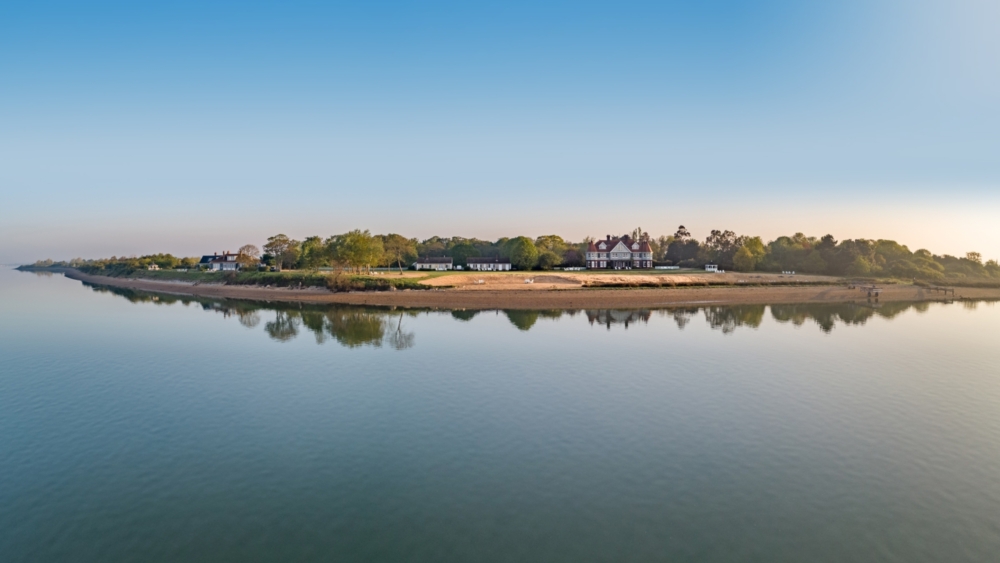
Osea Island: South Point. Mainland in the distance.

Osea Island: South Point. Mainland in the distance.

Entries in this series:
  1. Osea Island - Preface: Part I
  2. Osea Island - Preface: Part II
  3. Osea Island - Preface: Part III